Blog Automation Tools Comparison for Search Rankings: 13 Best Picks in 2025
If you’re reading this, chances are you’re tired of the same old SEO grind. Keyword research that takes forever. Content briefs that feel like a chore. Technical audits that eat up your entire day. We get it. But here’s the thing: the smartest teams aren’t working harder—they’re working smarter with blog automation tools that actually move the needle on search rankings.
At Hiland SEO, we’ve tested dozens of automation platforms to see which ones deliver real results versus those that just promise the moon. The truth? Not all blog automation tools are created equal. Some will save you hours every week while boosting your organic traffic. Others will drain your budget faster than they improve your rankings.
In this comparison guide, we’re breaking down the best blog automation tools for search rankings in 2025. We’ll show you which ones are worth your investment, what they actually do (no marketing fluff), and how to pick the right tool for your specific needs. Whether you’re running a solo blog or managing content for multiple clients, you’ll find the insights you need to make a smart decision.
What Makes Blog Automation Tools Essential for Search Rankings

SEO automation is the process of automating repetitive SEO tasks you previously did manually, like managing meta tags, optimizing images, and tracking analytics. SEO optimization tools help marketers save time and resources while building an effective SEO strategy. Think about it: how much time do you spend on tasks that don’t actually require your expertise?
Tools that actually help you speed up your workflow and help you automate repetitive tasks within your SEO operation as a whole can drastically reduce your production time going from idea to publish. We’re not talking about tools that blindly generate content (we never recommend that). We’re talking about smart automation that handles the tedious stuff so you can focus on strategy and creativity.
The market for enterprise SEO platforms is booming for a reason. Enterprise SEO platforms will hit $58.3 billion by 2035, an annual growth of 17.68%. Why? Because businesses that automate their SEO processes see measurable gains in efficiency, accuracy, and results. Businesses using SEO marketing automation tools see a higher ROI on their marketing efforts. Automated workflows reduce the time to market, especially for campaigns requiring constant adjustments. Tools help smaller businesses compete with larger enterprises by leveling the playing field through actionable insights.
At Hiland SEO, we’ve seen firsthand how the right automation tools transform content operations. When you automate keyword tracking, technical audits, and content optimization, you’re not cutting corners—you’re eliminating bottlenecks that keep you from scaling.
13 Best SEO Automation Tools I’m Using in 2025
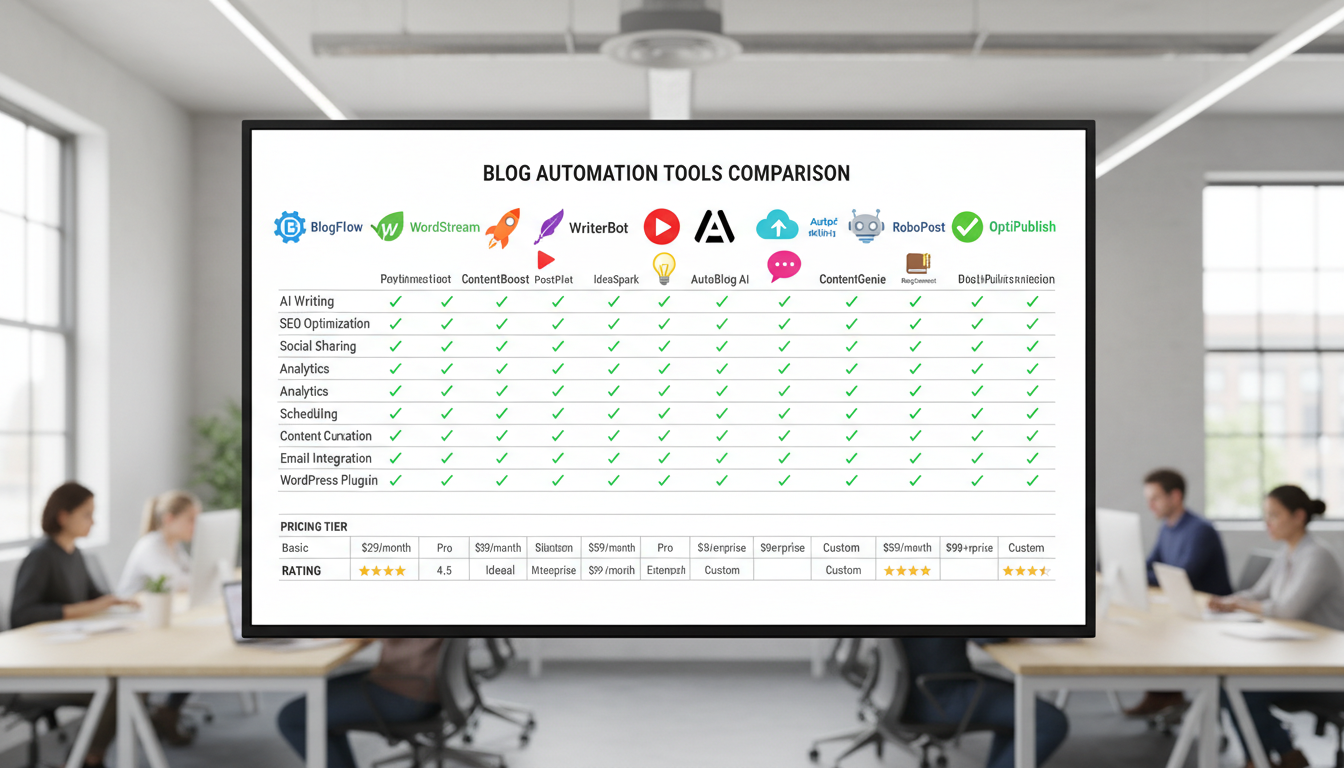
Let’s cut through the noise and talk about the tools that actually deliver results. Based on our testing and real-world experience, here are the platforms that stand out for blog automation and search rankings.
Semrush: The All-in-One Powerhouse
Semrush is basically synonymous with SEO. This rank tracker’s insights and features are robust and scalable enough to handle virtually all performance monitoring needs for SMBs and enterprises. There’s very little Semrush can’t do, but most of its utility caters to keywords, SERP analysis, and page ranking metrics.
What makes Semrush shine for blog automation? SEMrush also offers a content marketing platform that helps you write SEO-friendly blog posts and optimize them for the SERPs. It even has an SEO writing assistant that suggests content ideas and provides readability scores for your copy. The platform combines competitive analysis, keyword research, content optimization, and rank tracking in one place.
Key Features:
– Keyword Magic Tool for finding long-tail opportunities
– Position tracking with daily updates
– Content marketing platform with SEO writing assistant
– Automated competitor monitoring
Best For: SEO professionals and agencies who need comprehensive tracking and competitor analysis.
Surfer SEO: Data-Driven Content Optimization
Surfer SEO is a powerful cloud-based SEO automation tool specifically designed to enhance your content strategy and on-page optimization efforts. It stands out for its data-driven approach, analyzing the top-performing pages for your target keywords and providing actionable recommendations to improve your content’s ranking potential. This makes it an incredibly valuable asset for content marketers, SEO professionals, and anyone looking to boost their organic visibility.
Surfer’s Content Editor is its flagship feature. It provides real-time optimization suggestions as you write, helping you hit the right keyword density, content length, and semantic relevance. In 2025, Surfer introduced Grow Flow, an AI-powered task manager that scans your site weekly and provides actionable SEO improvements.
Key Features:
– Content Editor with NLP-driven suggestions
– SERP Analyzer for competitive benchmarking
– Grow Flow for automated weekly recommendations
– AI Outline Generator
Best For: Content teams who want to scale optimization across multiple clients or projects.
Ahrefs: Backlink Intelligence and Competitor Research
Ahrefs is an excellent tool that automates technical SEO tasks like site audits, backlink analysis, competitor analysis, and more. Ahrefs automates site audits by scheduling them on a pre-set schedule that you create, which crawls your entire site and checks each page for over 170 technical and on-page SEO issues. It detects issues like broken links, slow page speed, and redirect loops.
Ahrefs excels at automating the discovery of link-building opportunities and competitive intelligence. Ahrefs can also automate an organic keywords report, which gives you a list of all the keywords that any given site ranks for, along with the estimated search volume for each keyword. This tool helps you discover low-hanging fruit keywords and featured snippet opportunities.
Key Features:
– Massive backlink database
– Automated site audits on custom schedules
– Organic keywords report
– Content Explorer for finding link opportunities
Best For: SEO professionals who need detailed backlink analysis and competitor research.
Search Atlas with OTTO SEO: AI-Powered Automation
Search Atlas brings something different to enterprise SEO: pure AI horsepower. Its OTTO SEO agent doesn’t just analyze pages, it executes optimizations directly on websites. That means automated title tags, meta descriptions, and image alt text.
OTTO stands out because it actually implements changes for you (with your approval). Their comprehensive SEO suite even includes the first-of-its-kind AI agent, OTTO SEO. This groundbreaking assistant automates the entire SEO process. Rather than just making suggestions, it identifies opportunities to optimize and executes them with a single click. OTTO automatically fixes technical issues, optimizes and generates content, optimizes GBP, and much more.
Key Features:
– OTTO AI agent for one-click optimizations
– 5.2 billion keyword database
– Daily ranking updates
– Automated technical fixes
Best For: Teams who need AI-driven execution, not just recommendations.
Clearscope: Content Decay Detection
The way I’ve used Clearscope a lot in the past has been for content optimization, but the feature I really love is the Content Decay feature. It helps you quickly figure out which pages are losing traffic and need to be updated. While you can do this in Google Search Console by comparing previous date ranges and sorting by pages with the highest negative click difference, Clearscope just automates the entire process and tells you exactly what pages are decaying and need your attention.
This is a game-changer for maintaining existing content. Instead of manually tracking performance drops, Clearscope automatically flags content that needs refreshing.
Key Features:
– Automated content decay detection
– Content optimization scoring
– Competitor analysis
– Real-time optimization suggestions
Best For: Content marketers managing large content libraries who need to maintain rankings over time.
SE Ranking: AI Overviews Tracking
SE Ranking is another tool that’s great if you’re an agency that wants to automate SEO reports for your clients. Specifically, I added SE Ranking to this list because it’s good at AI Overviews tracking. Given that AI Overviews are the craze right now, there are a lot of different tools trying to help publishers and website owners understand how their traffic is performing when it comes to search rankings in AI Overviews.
As AI-driven search becomes more prevalent, tracking visibility in these new formats is critical. SE Ranking helps you stay ahead of this trend.
Key Features:
– AI Overviews tracking
– Automated client reporting
– Keyword tracking and site audits
– Competitive analysis
Best For: Agencies tracking AI-driven search trends and optimizing client campaigns.
MarketMuse: Content Strategy Automation
MarketMuse is an AI content strategy tool that performs competitive analysis and helps you build authority by analyzing your existing content and identifying strategic opportunities. MarketMuse’s content brief tool automates the creation of content briefs, which can be a time-consuming step in your SEO strategy. It also has a competitive content analysis feature to determine content gaps, and a content optimizer that tells you what topics you’ve missed in real-time. The core benefit of MarketMuse is its emphasis on building topical authority by helping you plan, create, and optimize content at scale. It removes the subjectivity from content strategy by providing data-driven recommendations on how to create content that improves your ROI.
If content briefs are slowing you down, MarketMuse can save hours every week.
Key Features:
– Automated content brief generation
– Competitive content analysis
– Real-time content optimizer
– Topical authority scoring
Best For: Content strategists who want data-driven recommendations for building authority.
Frase: SERP Research and Content Optimization
Frase delivers exceptional value by combining SERP research, AI writing, and content optimization in one streamlined platform at $45/month. The automated content brief generation saves significant research time, while integrated AI writing tools help overcome writer’s block and speed content production. However, keyword recommendations lack the precision of premium competitors like Surfer or Rankability, and AI-generated content often needs substantial human editing for quality and accuracy.
Frase is perfect for small teams on a budget who need comprehensive features without breaking the bank.
Key Features:
– SERP research automation
– AI writing assistance
– Content optimization scoring
– Automated content briefs
Best For: Small businesses and individual creators who need affordable, comprehensive automation.
AirOps: Workflow Builder for Content Operations
AirOps is a platform that allows you to automate the content operation parts of your SEO workflows. Workflow Builder allows you to create automations very similar to Gumloop that help you research content to write, help you create it, help you automate it, and help you with optimization.
AirOps shines when you need custom workflows tailored to your specific content process.
Key Features:
– Custom workflow builder
– AI Copilot for no-code automation
– Power Steps for reusable workflows
– LLM integration
Best For: Content marketing teams focused on creating editorial content at scale.
Screaming Frog: Technical SEO Audits
Screaming Frog definitely takes a spot on our list of the best SEO automation tools. Many SEO experts use this tool to automate everyday SEO tasks. Screaming Frog is mostly known for its SEO Spider, which allows you to automatically crawl websites, find issues such as broken links, repetitive content, and slow page loading, analyze metadata, audit redirects, etc.
For technical SEO, Screaming Frog is unbeatable. Screaming Frog’s SEO Spider generates automated reports containing essential SEO metrics to help pinpoint any issues. You can compare these reports after some time (a process you can also automate) to see your improvements.
Key Features:
– Automated website crawling
– Technical issue detection
– Metadata analysis
– Automated reporting
Best For: SEO professionals who need in-depth technical audits.
Rank Math: WordPress Plugin Automation
Rank Math is a powerful WordPress plugin designed to streamline your search engine optimization (SEO) efforts through automation. It brings a comprehensive suite of tools directly into your WordPress dashboard, making on-page optimization significantly easier for both seasoned SEO professionals and those just starting out. Its popularity stems from its ability to automate tedious SEO tasks, freeing up valuable time for content creation, strategy, and other crucial aspects of digital marketing.
One of the standout features of Rank Math is its automated on-page SEO analysis. This feature scans your content and provides actionable recommendations for improvement, covering crucial elements like keyword density, meta descriptions, heading tags, and image alt text.
Key Features:
– Automated on-page SEO analysis
– Schema markup automation
– Internal linking suggestions
– SEO score tracking
Best For: WordPress users who want comprehensive SEO automation built into their CMS.
HubSpot SEO Tools: Integrated Marketing Platform
HubSpot is a powerful SEO marketing automation tool offering AI-driven content creation features. Its many tools help marketers create SEO-friendly content that drives organic traffic. Key features include tools for generating blog posts, landing pages, and marketing emails, automatically scans websites to identify improvement opportunities ranked by priority, enhances old content and provides new topic ideas using AI and Semrush keyword data. HubSpot offers an integrated content creation and SEO approach, perfect for maintaining a consistent output.
Key Features:
– AI-driven content creation
– Automated website scanning
– Content reoptimization suggestions
– Integrated marketing workflows
Best For: Marketing teams who want SEO integrated with their broader marketing automation.
Link Whisper: Internal Linking Automation
This feature ensures that relevant content is interconnected, enhancing the site’s SEO and helping users discover related articles. I use the auto-linking feature a lot. Every time a new page goes live, I use LinkWhisper to find keywords for which I want the page to rank. The AI finds the opportunities, and you can link them automatically or approve them.
Internal linking is tedious but critical for SEO. Link Whisper automates the discovery and implementation of internal link opportunities.
Key Features:
– AI-powered link suggestions
– Automated internal linking
– Bulk link adding
– Orphaned content detection
Best For: Content creators who want to strengthen site structure without manual linking work.
What to Look for When Choosing SEO Automation Tools

Here are a few things I think you should pay attention to when looking for an SEO automation tool: Integration with your existing tools: Think GSC, Google Analytics (GA4), Semrush, etc. It should fit into your current tech stack. LLM integration: Ideally, it lets you create AI agents or workflows with ChatGPT, Claude, or any LLM model. Data accuracy: No hallucinated data. You need reliable, valuable insights you can act on.
Don’t forget these other critical factors:
Team Collaboration Features: Whether you’re solo or managing a team, your tool should support collaboration and clear workflows.
Security and Data Privacy: Especially important if you’re connecting it to GSC or analytics. You don’t want your data sold.
Pricing That Makes Sense: It should cost less than hiring someone to do the same task manually (and most do). Consider your ROI carefully. Expensive doesn’t always mean better for your situation. I’ve seen small teams get incredible results with a $200/month budget (RankMath Pro + SE Ranking + Frase), while enterprise teams needed $2000+ monthly investments to see meaningful impact across their complex operations.
Customer Support: Many of these tools are new and evolving fast. You want fast support when something breaks.
At Hiland SEO, we help businesses choose the right automation stack for their specific needs. The best tool isn’t always the most expensive—it’s the one that fits your workflow and delivers measurable results.
How Blog Automation Tools Actually Improve Search Rankings
Let’s talk about the real impact. How do these tools translate to better rankings?
Speed and Efficiency
Keyword research automation isn’t about fancy AI promises or “revolutionizing your strategy.” It’s about raw efficiency: turning a 20-hour manual process into a 2-hour powerhouse of data-driven decisions. When you can research keywords, create briefs, optimize content, and track rankings in a fraction of the time, you publish more high-quality content that targets the right opportunities.
Consistency and Scale
Managing these tasks manually can be overwhelming and time-consuming, which is why many teams turn to SEO automation tools. SEO automation tools empower marketers by simplifying repetitive processes, providing data-driven insights, and ensuring that content consistently aligns with SEO best practices.
Consistency matters for search rankings. Automation helps you maintain quality standards across all your content, not just the pieces you have time to manually optimize.
Data-Driven Decisions
Modern keyword tools run through 50,000+ related terms in seconds, analyzing everything from search volume trends to click-through rates. They spot which terms drive conversions, not just traffic. And they tell you exactly which content types match user intent, so you’re not wasting time writing guides when users want comparison pages.
Automation tools process massive amounts of data to surface insights you’d never find manually. This means you’re targeting the right keywords with the right content format.
Technical Excellence
SEO automation catches these issues in real-time. Within minutes of a page slowing down, a link breaking, or a drop in ranking, you get an alert with the exact problem and solution. Technical issues kill rankings, but automation helps you catch and fix them before they cause damage.
Common Mistakes to Avoid with Blog Automation Tools
Automation is powerful, but it’s not a magic bullet. Here’s what to avoid:
Over-Reliance on AI Content Generation: I never advocate using AI to generate content you publish. Use automation for research, optimization, and technical tasks—not for replacing human creativity and expertise.
Tool Overload: Start with one primary tool, get comfortable with it, then layer in additional tools as your confidence and needs grow. Pro Tip: Don’t try to implement everything at once. Pick 2-3 tools maximum to start, master them over 90 days, then evaluate what gaps remain. This approach prevents tool overwhelm and actually gets you better results faster.
Ignoring Integration: Nothing kills productivity faster than tools that don’t talk to each other. Before you fall in love with any tool’s features, check how it integrates with what you’re already using.
Expecting Instant Results: Implementing AI SEO tools isn’t an overnight transformation. Plan for 2-4 weeks to properly set up and configure most tools, another 4-6 weeks to see meaningful data, and 3-6 months to see significant ranking improvements.
Blog Automation Tools Comparison: Quick Reference Table
| Tool | Best For | Key Strength | Starting Price | Top Feature |
|---|---|---|---|---|
| Semrush | All-in-one SEO | Comprehensive suite | $119.95/mo | Keyword Magic Tool |
| Surfer SEO | Content optimization | Real-time scoring | $52/mo | Content Editor |
| Ahrefs | Backlink analysis | Massive link database | $99/mo | Site Audit automation |
| Search Atlas | AI automation | OTTO execution | Custom | One-click optimizations |
| Clearscope | Content decay | Traffic loss detection | $189/mo | Content Decay feature |
| SE Ranking | AI Overviews | New search formats | Varies | AI search tracking |
| MarketMuse | Content strategy | Topical authority | Custom | Automated briefs |
| Frase | Budget-friendly | All-in-one value | $45/mo | SERP research |
| AirOps | Custom workflows | Flexible automation | Custom | Workflow Builder |
| Screaming Frog | Technical SEO | Deep site crawls | Free-$259/yr | SEO Spider |
| Rank Math | WordPress SEO | CMS integration | Free-$59/yr | On-page analysis |
| HubSpot | Marketing teams | Platform integration | Custom | AI content tools |
| Link Whisper | Internal linking | Link automation | $77/yr | Auto-linking |
Making the Right Choice for Your Blog
The best blog automation tool for search rankings depends on your specific situation:
For Solo Bloggers: Start with affordable options like Frase or Rank Math that deliver comprehensive features without enterprise pricing. Focus on content optimization and technical basics.
For Small Teams: Consider Surfer SEO or Clearscope for content optimization, plus Screaming Frog for technical audits. This combination covers your core needs without breaking the bank.
For Agencies: Semrush or Ahrefs provide the comprehensive features and client reporting you need. Add SE Ranking for AI Overviews tracking and automated reporting.
For Enterprises: Look at Search Atlas with OTTO for execution-level automation, or combine Semrush with MarketMuse for strategy and scale.
The key is to start with one or two tools, master them, then expand as your needs grow. Don’t try to implement everything at once. Most SEO teams waste money on overlapping tools. Start with one solid technical platform and add specialized tools as you scale. The best stack isn’t the biggest; it’s the one your team uses religiously.
Frequently Asked Questions
What’s the best blog automation tool for beginners?
For beginners, Frase offers the best balance of features and affordability at $45/month. It combines SERP research, content optimization, and AI writing assistance in one platform. Alternatively, if you’re on WordPress, Rank Math provides excellent automation features with a free version that’s perfect for getting started.
Can automation tools replace SEO experts?
No. Automation tools handle repetitive tasks and data processing, but they can’t replace human strategy, creativity, and expertise. The most successful teams use automation to amplify their expertise, not replace it. Tools handle the grunt work so experts can focus on strategy and high-value decisions.
How long does it take to see results from SEO automation tools?
Expect 2-4 weeks for setup and configuration, another 4-6 weeks to gather meaningful data, and 3-6 months to see significant ranking improvements. SEO is a long-term game, and automation accelerates the process but doesn’t eliminate the time required to build authority and rankings.
Are expensive SEO automation tools always better?
Not necessarily. Small teams have achieved incredible results with $200/month budgets by choosing the right combination of tools. The best tool is the one that fits your workflow and delivers ROI for your specific needs. Focus on integration, features you’ll actually use, and proven results rather than price tags.
Should I automate content writing for my blog?
No. While automation is powerful for research, optimization, technical audits, and tracking, you should never fully automate content creation. AI-generated content lacks the expertise, originality, and human touch that readers value and search engines reward. Use automation to support your writing process, not replace it.