
SEO Pricing: How Much SEO Costs and What You Should Get
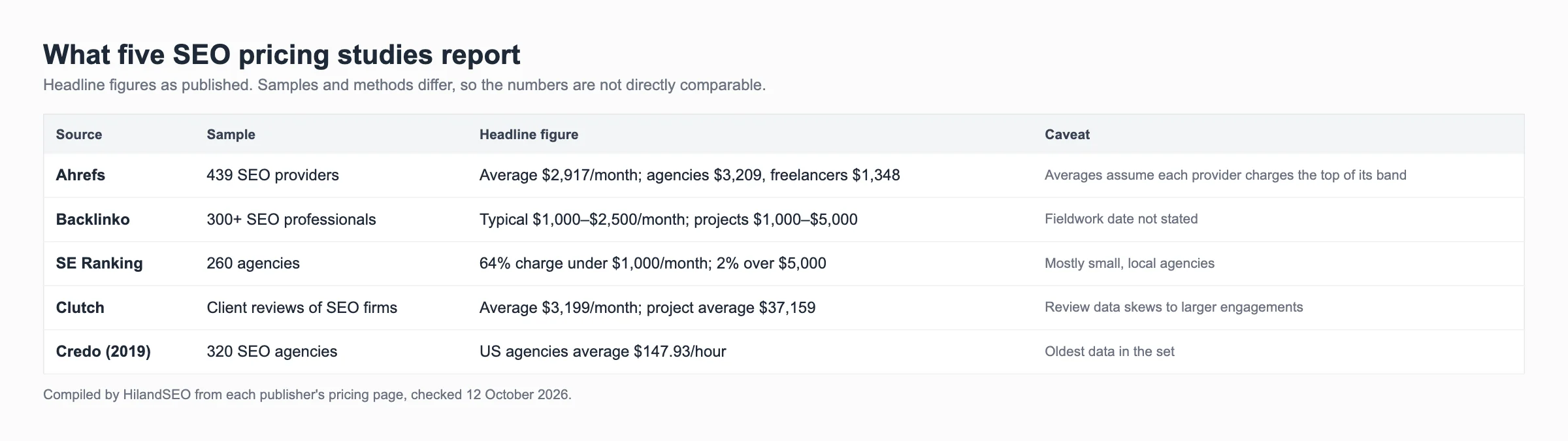
Most published surveys put a monthly SEO retainer somewhere between $500 and $5,000. Ahrefs reports an average of $2,917 a month, Backlinko puts the typical range at $1,000 to $2,500, and Clutch’s review data averages $3,199. SE Ranking, surveying mostly small local agencies, found 64% charge under $1,000. Most of the spread comes from who each survey asked.
I price SEO projects for Shopify and WordPress brands, so I see both sides: what agencies charge and what clients expected to pay.
Why the pricing surveys disagree
The headline numbers above look contradictory until you read the methods.
- Ahrefs polled 439 SEO providers. Its averages are calculated as if every provider charged the top of the price band they picked, so they lean high. The page doesn’t state when the survey was run; its visible update date is August 2024.
- Backlinko surveyed over 300 SEO professionals with one to ten-plus years of experience. Location matters a lot in its data: retainers under $500 a month were offered by 42% of providers in India and Latin America and only 7% in the US, UK and Australia.
- SE Ranking collected data from 260 agencies, most of them small and focused on local clients. That explains why only 2% charge more than $5,000 a month.
- Clutch isn’t a survey. Its figures come from client reviews of SEO firms listed on the site. The average project is $37,158.66, yet Clutch says the usual project costs under $10,000, so a few large engagements pull the average up. The typical timeline is 12 months.
The common pricing models
| Model | What the data shows | Best for |
|---|---|---|
| Monthly retainer | SE Ranking: $500–$1,000 most common; Ahrefs average $2,917 | Ongoing content, links and technical work |
| Hourly | Ahrefs average $111; Clutch $100–$149 | Advice, training, second opinions |
| Project | Backlinko: $1,000–$5,000 typical | Audits, migrations, one-off fixes |
| Fixed packages | Public tiers from $199 to $12,500 a month | Buyers who want set deliverables |
| Per article | Quoted per word or per post | Content-only engagements |
| Performance-based | No reliable survey data | Rarely a good fit; see below |
SE Ranking found 53% of agencies prefer monthly retainers. That matches what I see: SEO results build over months, and most of the work is ongoing.
Pay-for-rankings deals sound safe but push the provider toward whatever moves a number fastest, including tactics that break Google’s rules. Google’s own advice on hiring an SEO says: “If they guarantee you that their changes will give you first place in search results, find someone else.”
What public price pages show
A few agencies publish their prices. When I checked on 12 October 2026:
- OuterBox listed Essentials at $2,000 a month, Pro at $3,000 and Enterprise from $7,000, month to month.
- WebFX advertised SEO “starting at $3,000/month,” with a two-month initial investment from $8,600.
- Webtyde listed five packages from $950 to $12,500 a month.
- Other providers’ entry plans started between $199 and $699 a month.
Prices can differ even between one provider’s own pages: two WebFX pages showed different Silver-tier prices on the same day ($2,800 on one, $2,900 on the other). Whoever you hire, get the price and the deliverables in writing.
What drives the cost up or down
- Site size and catalog. A 30-page service site and a 5,000-product store need very different amounts of work.
- Competition. Ranking for “seo services” is a different job from ranking for a niche industrial part.
- Content volume. Writing is usually the biggest line item. Four researched articles a month cost more than four rewritten product descriptions.
- Links. Outreach and digital PR take time. Ask exactly where links come from and whether money changes hands.
- Technical debt. A site that Google can’t crawl properly needs fixing before content pays off.
- Markets and languages. Each extra country or language multiplies the work.
Two platform-specific drivers that pricing guides rarely mention, because they show up in audits rather than sales calls:
Shopify. Many apps inject code into every page. On one store I measured, product pages carried 6 to 8 MB of HTML, and Google reads only the first 2 MB. Fixing it means app settings or theme work, which adds developer time. Collection and filter URLs also need handling so Google doesn’t waste crawls on thousands of near-identical pages.
WordPress. Years of plugins, page-builder templates and abandoned tags create crawl waste and slow pages. Cleaning that up is often the first month of a WordPress engagement, and it should be quoted separately from content.
Paid links and “GEO add-ons”: check before you pay
Some quotes include a link budget. Google’s spam policies list “buying or selling links for ranking purposes” as link spam, including “exchanging money for links, or posts that contain links.” In a test published on a page last updated in July 2024, Ahrefs found paid niche edits averaged $361.44 and paid guest posts $77.80. If a quote includes links, ask for examples and whether they are paid.
AI search is the new add-on line. Google now tells buyers, in its page on hiring an SEO, to check whether advice on “AEO” or “GEO” is aligned with Google Search’s official guidance. That guidance says that, from Google Search’s perspective, optimizing for generative AI search is “still SEO,” and that for Google Search you can ignore “creating unnecessary AI text files (like llms.txt).” If a quote charges extra for llms.txt files or “AI chunking,” ask what result it is meant to produce. Real AI visibility work, like sampling answers and earning coverage on cited sites, is a reasonable line item. I wrote more about what llms.txt does and doesn’t do.
How to judge an SEO quote
Google’s “Do you need an SEO?” page is still the best buyer’s checklist I know. A few lines from it:
- “No one can guarantee a #1 ranking on Google.”
- If an SEO offers an audit, “only grant read access to Search Console (at this stage, don’t grant them write access).”
- “An SEO audit should be about giving you realistic estimates of improvement, and an estimate of the work involved.”
- “Be careful if a company is secretive or won’t clearly explain what they intend to do.”
- “Ultimately, you are responsible for the actions of any companies you hire.”
On top of that, I’d ask every provider these questions:
- What exactly is delivered each month: how many pages, articles and fixes?
- Who writes the content, and who checks the facts?
- Where do links come from? Can I see examples?
- How will you report results? Search Console clicks by page are hard to fake; “visibility scores” are easy.
- What is the minimum term, and what happens to the content if we stop?
Contract terms vary more than you’d expect. In Credo’s 2019 survey, 30.29% of providers had no minimum engagement and 29.77% required six to twelve months. A long minimum isn’t automatically bad, but it should come with a clear plan for those months.
The costs that aren’t in the quote
Most SEO fees don’t include the developer who implements technical fixes, the person on your side who approves content, or the tools you may need. Backlinko’s guide covers these hidden costs well. Before comparing two quotes, ask each provider which of these they handle and which land on your team.
How we price
Quick answers
How much does SEO cost for a small business? SE Ranking’s most common bands were $500 to $1,000 a month and $50 to $100 an hour. Google’s own page adds: “If you run a small local business, you can probably do much of the work yourself.”
Do freelancers cost less than agencies? In Ahrefs’ survey, freelancers averaged $1,348 a month and agencies $3,209.
How much should I charge for SEO? The same surveys are a fair benchmark: most retainers fall between $500 and $5,000 a month, depending on market and scope.
How we price
We quote after an audit, because the audit is what tells us how much work a site needs. The quote lists every deliverable, and we report on Search Console clicks you can check yourself.
You can see what’s included on our SEO services page.
Or start with an SEO audit.
If you are still deciding whether to invest at all, how long SEO takes to work is the other half of the budget question.