
Generative Engine Optimization (GEO) Services
Buyers now ask ChatGPT and Google’s AI answers which product or supplier to pick. We find out what those answers say in your category, which pages they cite, and what it takes for your brand to be one of them.
- ChatGPT, Gemini, Perplexity, AI Overviews
- Answers sampled from live AI tools
- Built on SEO that already works
We start by asking the questions your buyers ask
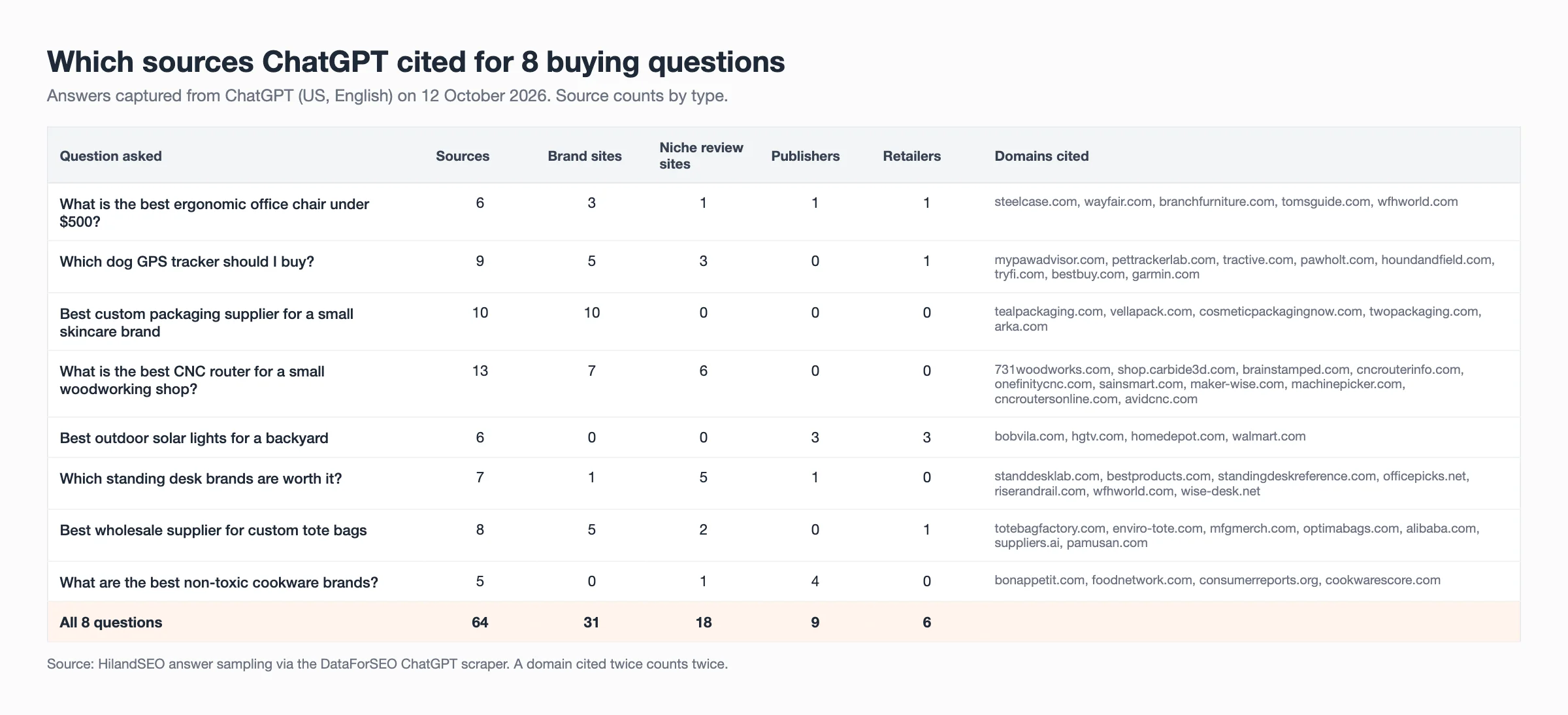
We put your buyers’ questions to AI assistants and record every source they cite. In one sample of 8 buying questions on 12 October 2026, ChatGPT gave 64 citations: 31 to brand websites, 18 to niche review sites, 9 to publishers and 6 to retailers.
The mix changes by category, so we sample yours before planning any work.
What GEO work includes
Answer sampling
A fixed set of buyer questions, asked on ChatGPT, Gemini, Perplexity and Google AI Overviews. We re-run it monthly and track how often you appear.
Crawler access
We check robots.txt and CDN rules for OAI-SearchBot, GPTBot and PerplexityBot, plus the Google-Extended robots.txt token, which covers Gemini but not AI Overviews.
Facts AI can quote
Specs, prices, materials and FAQs in plain HTML, not locked in images or scripts. Structured data that matches the page.
Consistent brand facts
Your company name, product names and key facts should read the same on your site, marketplaces and directories.
Coverage where AI looks
We find the review sites, lists and forums AI cites in your category and work on getting your brand covered there.
The SEO underneath
AI answers in Google draw on indexed pages. If your pages are not indexed or crawlable, we fix that first.
How GEO relates to SEO
Google’s AI optimization guide says that, from Google Search’s perspective, optimizing for generative AI search is “still SEO.” It also lists creating unnecessary AI text files like llms.txt among the tactics you can ignore for Google Search.
Our GEO work adds answer sampling and third-party coverage to the SEO groundwork.
How a GEO engagement runs
1
Sample
Agree the buyer questions and engines, then record today’s answers and sources.
2
Diagnose
Check crawler access, indexing and how your key pages present facts.
3
Fix
Technical and on-page changes, each backed up and reversible.
4
Earn coverage
Work on the sources AI cites most in your category.
5
Re-sample
Monthly re-runs show where you now appear and where you don’t.
GEO services FAQ
What is generative engine optimization and how does it work?
How is GEO different from SEO?
Can you guarantee ChatGPT will recommend us?
Do I need an llms.txt file?
Which AI tools do you track?
See what AI says about your category
Send us your site and three questions your buyers ask. We will show you the answers and the sources behind them.